

Today, our eyes are so used to seeing smooth and clean images that a pixelated photograph is seen as a resolution error. However, there is a real trend toward pixel art that we can call "Pixel Art."Between nostalgia and modernity, discover the best artists who have marked this movement.
In broad strokes and little squares… An artistic movement that still captivates

Pixel Art emerged in the 1970s with the arrival of computers in homes, largely thanks to the birth of graphic design, especially video games. Among them were arcade games like Space Invaders and Pac-Man. Thanks to progress, more and more people gained access to computers and encountered pixels every day. The term Pixel is actually much older. Etymologically, the word pixel comes from the abbreviation of two English words: "pictures" and "elements." Literally, it can be translated as "picture element." Now that this literary tidbit has amazed you, let’s move on!
From a technical point of view, the pixel appeared as early as the 1880s with the arrival of the first screens. They are the dots of an electronic image. This invention is credited to computer scientist Russel Kirsch, a pioneer of digital imaging.

The pixel draws its source from very ancient arts. We can even say it’s an ancestral technique because during antiquity it was already used for mosaics, for example. In fact, we find these images made from small colored units in many traditional art techniques over the centuries. In Impressionism, Cubism, and even embroidery.


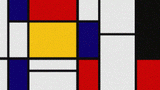
Visually, Pixel Art has always been present in art, but it was in the 1980s and 2000s that the term emerged along with many artists. Pixel Art is a varied art form, rich in ideas and above all limitless. The recipe? Imagination, little squares, colors, and voilà! (well, almost…)
Interested? To inspire you, here are some of the best Pixel Art artists.
The pioneering artists of the movement
Invader: the artist who breaks the rules by including Pixel Art in street art

He was born in Paris in 1969. A student at the École nationale supérieure des beaux-arts de Paris. He began his career in 1996 in Paris by posting his works on walls, then went on to conquer the world by posting in major international metropolises. A fan of an "old-school" style, he creates his works using special materials like tile mosaics or tesserae.

He defines himself as a hacker of public space by spreading a mosaic virus in the streets. Moreover, his works are not placed randomly. The artist carefully chooses the ideal spot to implant his virus. He prefers to exhibit in places with high foot traffic. Like a website, his virus must be able to penetrate the system. However, he sometimes also chooses more isolated spots. He sees himself as an urban acupuncturist. Each of his works is unique. His characters are first inspired by his childhood game “space invader.” Today he broadens his repertoire to offer us many references to pop culture.
Today he has already created more than 4000 works in 79 different cities. And yet, no one has ever seen his face! In short, he is a very versatile artist who offers us a mix of street art and Pixel Art to create unique works and captivate the world.
So, did Invader inspire you as much as us?
The Pixel Art of the eboy collective

Eboy is a Pixel Artist collective based in Los Angeles, founded in 1997 by Kay Vermehr, Steffen Sauerteig and Svend Smital (3 Berliners and 1 New Yorker). Their complex “modern” style illustrations are always full of cinematic, musical, and cultural references. This results in rich, colorful creations where you can always find a reference that will make you smile. Not to mention their humorous touch found on their various posters. Their works have been turned into t-shirts, souvenirs, and posters. Some are even exhibited in galleries. But think about artwork transportation!

They started working with pixels because they liked the idea of creating and imagining a universe made of pixels.
They mainly work with Photoshop but also with the Pen tool. It’s a simple tool that works like a pencil. Using this method, they create basic elements, trees, houses, and human figures which they store in a database. After that, they compress them in their library to then merge and articulate them together. They stand out especially for the fineness of their lines, very playful.
Very inspired by Pop culture
Their influences come from Pop culture. TV, toy ads, LEGO universe, computer games, news, and magazines. Kai was greatly inspired by the Nintendo universe because he played on the Nintendo DS. The other group members lived in East Germany, where video games were very rare or even nonexistent.

Their work reflects a colossal investment: "If we don't work on other projects at the same time, it takes about six to eight weeks to finish a very detailed urban landscape, three eBoys work on it almost full-time. But if we have to do it in our free time, which often happens, it could take years to finish a picture since we can't dedicate that much time." Their style has earned them a cult following among graphic designers worldwide as well as a long list of clients. They have done other projects like plastic toys. Peecol with Kidrobot, and a line of wooden toys is to be produced under their own label. Basically, we are dealing with a versatile, creative, and ultra-productive collective, so, are you in?
Pointillism and Pixel Art: Ced Vernay

Ced Vernay is a French artist who lives and works in Marseille. He uses the technique of the dot or pixel. Greatly inspired by Roman art, his work lies between Roman mosaic and pixel. A blend of modernity and tradition, a form of contemporary pointillism based on mathematical concepts.
It's a bit complicated! But you'll see it's worth it. A unique contemporary art concept, inspired by modern art galleries or artists like Andy Warhol, Roman Opalka, and Yayoi Kusama. Doesn't ring a bell?


These are innovative artists playing with pointillism. Ced Vernay did not venture into the world of Pixel Art combined with pointillism by chance. He worked for many years in web design and IT. By working around the pixel, he aims to question our relationship with the screen but also to explore an abstract and figurative universe.
Pixced, an artistic concept and monumental paintings that can be separated and shared

The artist embarked on large-scale projects. One of the features of this atypical work is assembling 20 x 20 cm squares, all different, which he calls PixCed.

"Each one is unique, with characters, symbols, mathematical formulas, drawings from their imagination or associated with things they wanted to express." It’s also a participatory work; indeed, you can add your own pixel to the piece. Buying one or more PixCed is also joining a community around a work of art: the Pix’Ced Community. This community might one day come together to bring these monumental works back to life. Buyers could one day become the actors in the reconstruction of the monumental artwork. Moreover, for every pixel purchased, a tree is planted through the Reforest’Action association. Ced VERNAY decided to offer this green gesture to his collectors because he is particularly sensitive to environmental issues. He has always tried to create works where the material is recycled. Pretty great, right? So why not you?
Aire makes its Pixel Art with PIXI Aire

We’re so inspired at Aire that we invite you to dive into custom Pixel Art creation. Not bad, right? And yes, we’re fans of Pixel Art too (you probably guessed it!). That’s why we launched the Pixi Aire project some time ago. It’s a Pixel Art game in puzzle form. Depending on your desires, you can get a kit of 50 black and 50 white pixels or 100 colored pixels. Then let your imagination run wild!
The Pixi Aire has a magnetic fastening system that allows you to hang it on your door or fridge. Of course, the Pixi Aire can also be attached to a pegboard thanks to our 3D parts kit. You can bring your ideas to life and let your creativity shine by drawing inspiration from the great figures of the Pixel world. Feel free to repurpose the Pixi Aire to create an original signage solution. You can now become a true artist and create your own Pixel Art designs or get inspired by your favorite references! The Pixi Aire is a Puzzle infinite and easy to set up.
In short
In conclusion, theThe aesthetic notion of creations related to Pixel Art is recent. It’s a diverse universe, born from techniques as old as time. It’s an artistic movement that includes other artistic movements within it. In short, it’s a super varied world offering content for all tastes. Appreciating Pixel Art means highlighting the beauty of both the pixelated graphic images and the technique used to create them. The beauty of this art lies in its simplicity: arrangements of large colored pixel blocks in a square format. You either love or dislike Pixel Art, but you have to admit that this new form of graphic art is a style of expression embedded in pop culture. It has marked its era and will surely continue to influence generations.
So, are you captivated by the world of Pixel Art? Go for it!
0 comments